


Infusion therapy: what it is
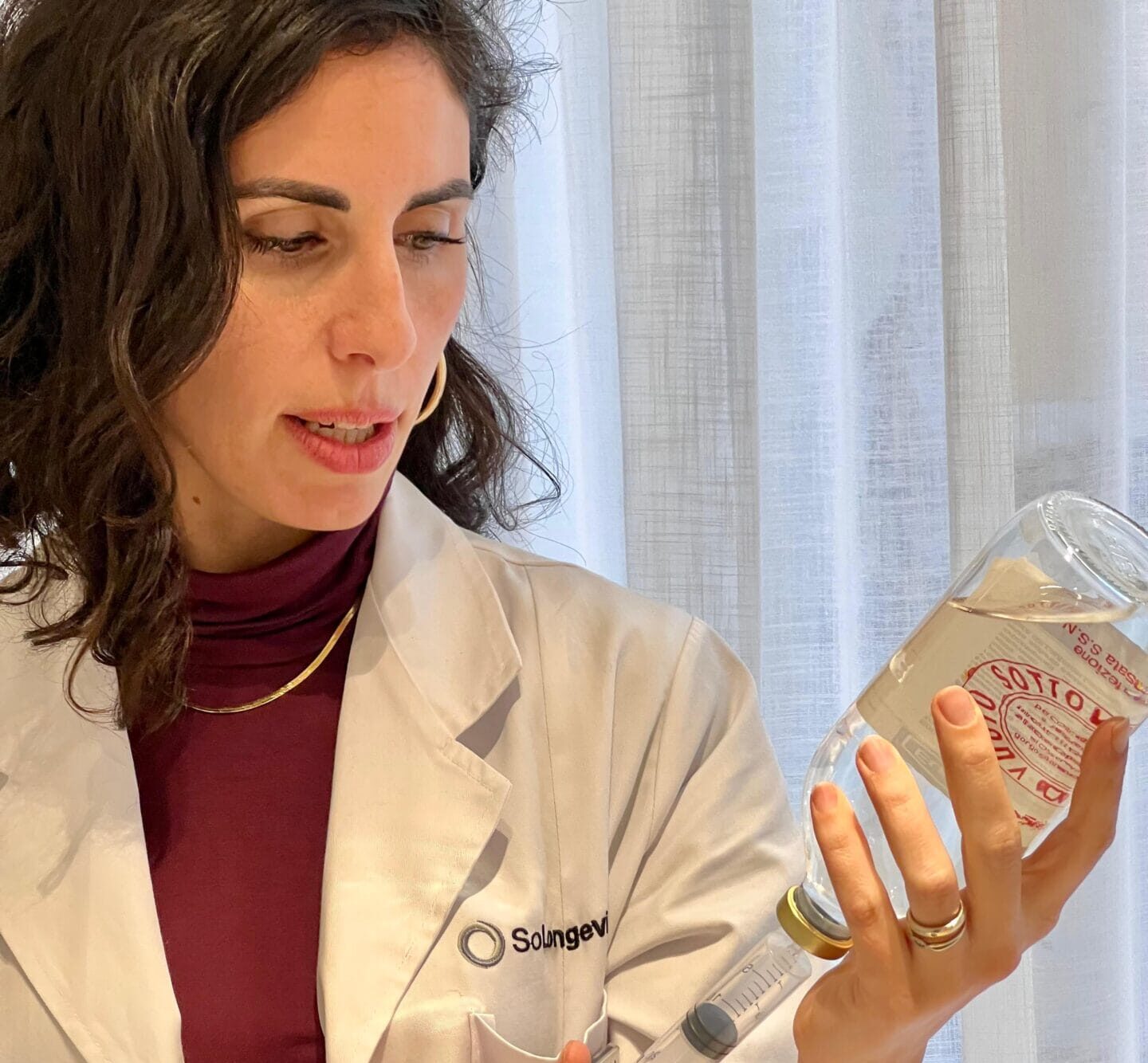
Infusion therapy consists of the intravenous (IV) administration of substances aimed at enhancing certain functions or at making up for deficiencies, for example of vitamins or minerals.
SoLongevity’s offering is based on the concept of personalization: each element provided through intravenous infusion therapy is chosen and calibrated precisely on the basis of what is considered most suitable, person by person.
In this context, infusion therapy has a preventive, therapeutic and enhancement value, because it aims to provide everything the body needs to function at its best and be in ideal conditions to stay healthy over time. Intravenous administration, unlike oral administration, allows 100% bioavailability of the nutrients administered and the use of higher dosages.
In the field of longevity medicine, moreover, antioxidant molecules have been studied, such as those that work on the mitochondria, considered today the superstars of anti-aging: their aim is to increase the activity of these organelles in all cells, for an “anti-aging booster effect“.
These are safe protocols, because they have been widely studied and are based on well-known molecules, and are adapted for tailored treatments. As a rule, cycles of treatment are carried out, consisting of 5 to 10 infusions. The elements most frequently used are B vitamins, vitamin C, magnesium and other trace elements, amino acidsAmino acids are the basic substances that make up proteins. Each protein is characterized by a precise sequence of amino acid "bricks". Some are produced by the body by processing food, others, which the body cannot synthesize, must be taken directly with food. and glutathione.

AGE360 Therapies
What are the main functions of infusion therapy?
Infusion therapy has two main objectives, as explained by Roberta Costanzo, physician expert in Regenerative and Enhancement Medicine at the SoLongevity Clinic: “It can be performed as supplementary therapy: if there are deficiencies, exactly the nutrients that are missing are administered; in some cases even a single nutrient is enough to make a difference. Or it can be performed as enhancement therapy: that is, the body is already in a state of balance, but the environmental stressors are such that support becomes necessary”. It can happen to anyone: students, athletes, older adults who have lost some physiological or neurological skills, such as memory or the ability to concentrate, women in peri- and post-menopause who suffer from so-called brain fog (mental fog).
In all these cases it is possible to intervene by enhancing functions with personalized protocols, giving the patient the right mix of elements they need to respond to stress factors.
Why must infusion therapy be personalized?
It is important to stress that infusion therapy is a medical procedure in every respect, and as such it must also be interpreted from the point of view of possible side effects. “Therefore, even when we act from a preventive perspective, we need to understand exactly what the patient needs and administer the best therapy for that person at that time, obviously also taking into account sex-gender differences.
Today, in fact, the trend is to use pre-made bags of nutrients. According to Roberta Costanzo, however, both in terms of dosages and composition, using ready-made mixes for infusion therapies is more or less equivalent to eating “a simple plate of vegetables or fruit. Mixes that are suitable for everyone, in fact, contain a little of everything. As a result, the substances cannot be present at dosages considered ‘therapeutic’. The patient may feel good immediately, but in most cases this is a consequence of rehydration, not so much of the nutrient intake. So we cannot speak of real therapy”.
The real benefit of an infusion therapy should be felt for a long time, even after the end of the infusion cycle.

Terapie IV
For which conditions can infusion therapy be useful?
There are many conditions in which supplementation through infusion therapy has a therapeutic value in the strict sense. Take fibromyalgia and insomnia as examples: “We have molecules that can be administered and that have activity at the level of the central nervous system — Costanzo explains — As a rule, this approach is combined with other strategies and pathways. The final goal is to bring the system back into balance”.
It is also essential to combine infusion therapy with a correct lifestyle, that is, with correct eating habits and regular physical activity. Because, Costanzo reminds us, it is not enough to bring the patient from a condition of disadvantage or balance to one of advantage: one must make sure that they are then able to maintain it.
The importance of clinical assessment
Whatever the goal, in order to achieve it, it is necessary first of all to proceed with a correct clinical assessment: “Precisely because infusion therapy is a medical procedure, diagnostic tests are needed, starting with blood chemistry, and a careful medical history. Where blood chemistry tests and the medical history are not sufficient to assess the case correctly, there are somewhat more advanced tests, such as metabolomics, which is one of the precision diagnostic tests and makes it possible to take a snapshot of the patient’s metabolic state. Another test is gut screening, that is, screening of the microbiota”.
One could also be faced with a situation in which, rather than adding, it is necessary to remove: “For example in cases of intoxication from heavy metals or other contaminants, of dysbiosis, or of infections — the expert continues — There are many factors that can disturb the body’s balance even before the nutritional deficiency itself arrives. And often the two are also related”.
What are ozone infiltrations?
An example of infusion therapy is cycles of ozone infiltration (or ozone therapy), also available at the SoLongevity Clinic. “It is a very useful anti-aging therapy, because it helps the metabolic activation of all cells and the release of oxygen at the peripheral level, promoting capillary circulation, which becomes less efficient with aging”, Costanzo explains.
The benefits are many, Costanzo concludes: “Ozone has an immunomodulatory capacity: depending on the dosages used, it is able to activate the endogenous antioxidant systems. That is why it is important to know the situation of the person to whom I want to propose this type of infusion therapy. If, in fact, there is an underlying deficiency of antioxidant elements, it is pointless to propose ozone therapy without first restoring them”.
Ozone infiltrations: contraindications
Intravenous systemic ozone therapy is contraindicated in favism and uncompensated hyperthyroidism, and requires caution in pregnancy, in people with epilepsy and in competitive athletes.


