



There are many questions online about dietary supplements and nutraceuticals: products on which scientific research has been very prolific for some years now. We put some of the most common questions to the experts at SoLongevity, an Italian company specializing in the formulation of new-generation nutraceuticals and in clinical protocols for healthy longevity within the SoLongevity Clinic.
What is meant by a dietary supplement?
As regards the definition, we report that of the European Food Safety Authority, where they are described as concentrated sources of nutrients or other substances with nutritional or physiological effects, marketed in “doses”, that is, pills, tablets, capsules, vials and so on. They can contain a wide range of nutrients and other ingredients, including vitamins, minerals, amino acidsAmino acids are the basic substances that make up proteins. Each protein is characterized by a precise sequence of amino acid "bricks". Some are produced by the body by processing food, others, which the body cannot synthesize, must be taken directly with food., fatty acids, fiber and various plant extracts.
What makes nutraceuticals different from dietary supplements?
From a regulatory point of view, in the European Union nutraceuticalNutraceutical is a syncratic neologism from "nutrition" and "pharmaceutical" coined by Stephen de Felice in 1989. Nutraceuticals are those nutrients contained in foods that have beneficial effects on health, their effectiveness has been proven by clinical trials. products are not defined separately, and therefore fall into the category of dietary supplements. In Italy, in order to be marketed, supplements must be approved by the Ministry of Health and entered in a register. On our website there are in-depth articles on these aspects (link).
What does nutraceutics treat? And what is the difference between a supplement and a drug?
Supplements and drugs differ in several respects, but there is no single answer to this question, because a lot depends on the type of supplement we are considering. First of all, it must be said that in the European Union dietary supplements are regulated as foods, while drugs are regulated by the European Medicines Agency (EMA).
There is, however, a very important conceptual difference to start from: a drug is taken almost always to treat a disease or a symptom, so its efficacy is easily perceptible and measurable; even when it is prescribed for prophylaxis, its effect is evident and measurable.
A supplement, on the other hand, is taken almost always to prevent pathological conditions from setting in and works on basic mechanisms of cellular functioning. The consequence is that it is not always possible to perceive its effect. There are tests that can measure its efficacy, but — depending on what one wants to measure — not many laboratories perform them, they are often expensive and physicians rarely prescribe them.
What effect do dietary supplements have? And how can I tell if the supplement is working?
For the reasons we have just explained, only in some cases can we perceive whether and how a supplement is improving our health or our state of well-being. It is possible, for example, when a supplement works on a problem we feel, for example a sense of fatigue. In the case of supplementation with NAD+ precursors, for example, the effect on the increase in perceived “energy” is generally very evident. This is the case of our nutraceutical CellFasting, which is a regenerator of mitochondrial energy. It is important here to stress that some symptoms such as, precisely, fatigue, can depend on many causes including iron deficiency, so it is always necessary to investigate the reasons for a persistent symptom. In general, before taking a supplement on a long-term basis, it is always advisable to have some tests.
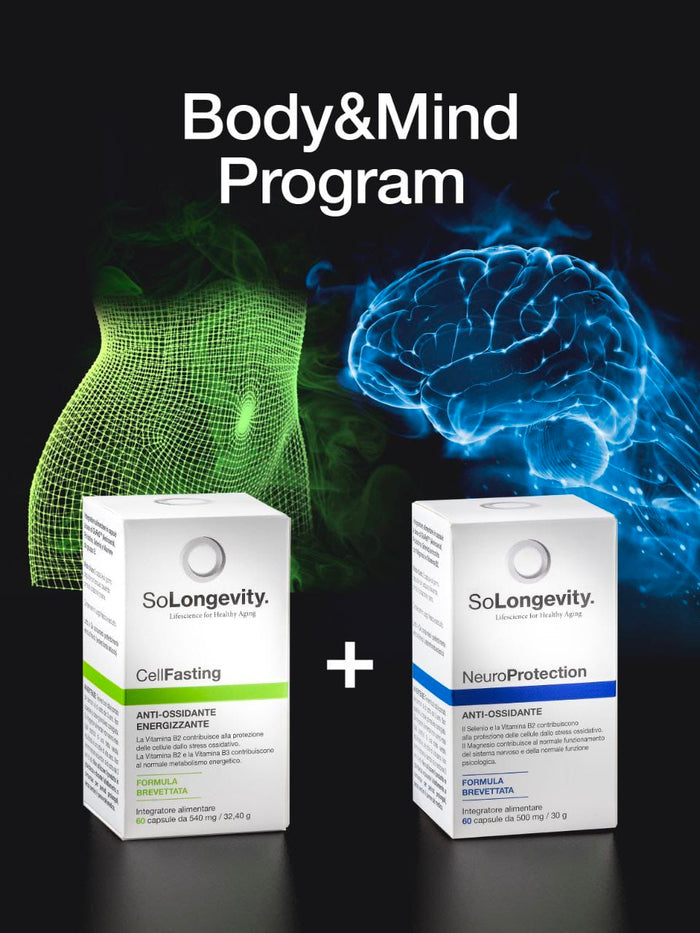
Other supplements in our line — in particular CardioAge, which works on the microcirculation, and SolImmune and SolImmune Boost, which work on the metabolism of the immune system — cannot have perceptible effects, also because they really act in the area of prevention and not of treatment. The most evident effect of NeuroProtection, which also acts on the circadian rhythm, is on sleep quality, while AminoAge, which promotes protein synthesis, including at the muscle level, improves muscle tone and strength in the medium to long term. This is a perfect example of a nutritional supplement that we know to be particularly useful for the over-60s, when a mechanism called anabolic resistance sets in, slowing the assimilation and breakdown of dietary proteins into amino acids, which are indispensable for new proteins.
Confirmation that all these nutraceuticals act as we wish comes from the laboratory and clinical tests we carry out.
How long before you can expect an effect?
Here too a lot depends on the nutraceutical in question. In general, at least 2-3 months are needed, although supplements such as CellFasting can make an improvement perceptible after just one month. AminoAge also acts quickly: the amino acids are synthesized immediately, although it may take longer to perceive a change.
Who prescribes nutraceuticals? And how should they be taken?
Since they are not drugs, a nutraceutical (or dietary supplement) does not need to be prescribed by a physician, although, as we have said, a consultation is always advisable before long-term use. The way they are taken is also fundamental: beyond subjective perception, for nutraceuticals to have their effect the indicated dosage must be respected. Lack of compliance, which also occurs with drugs, is in fact even more widespread with supplements.


